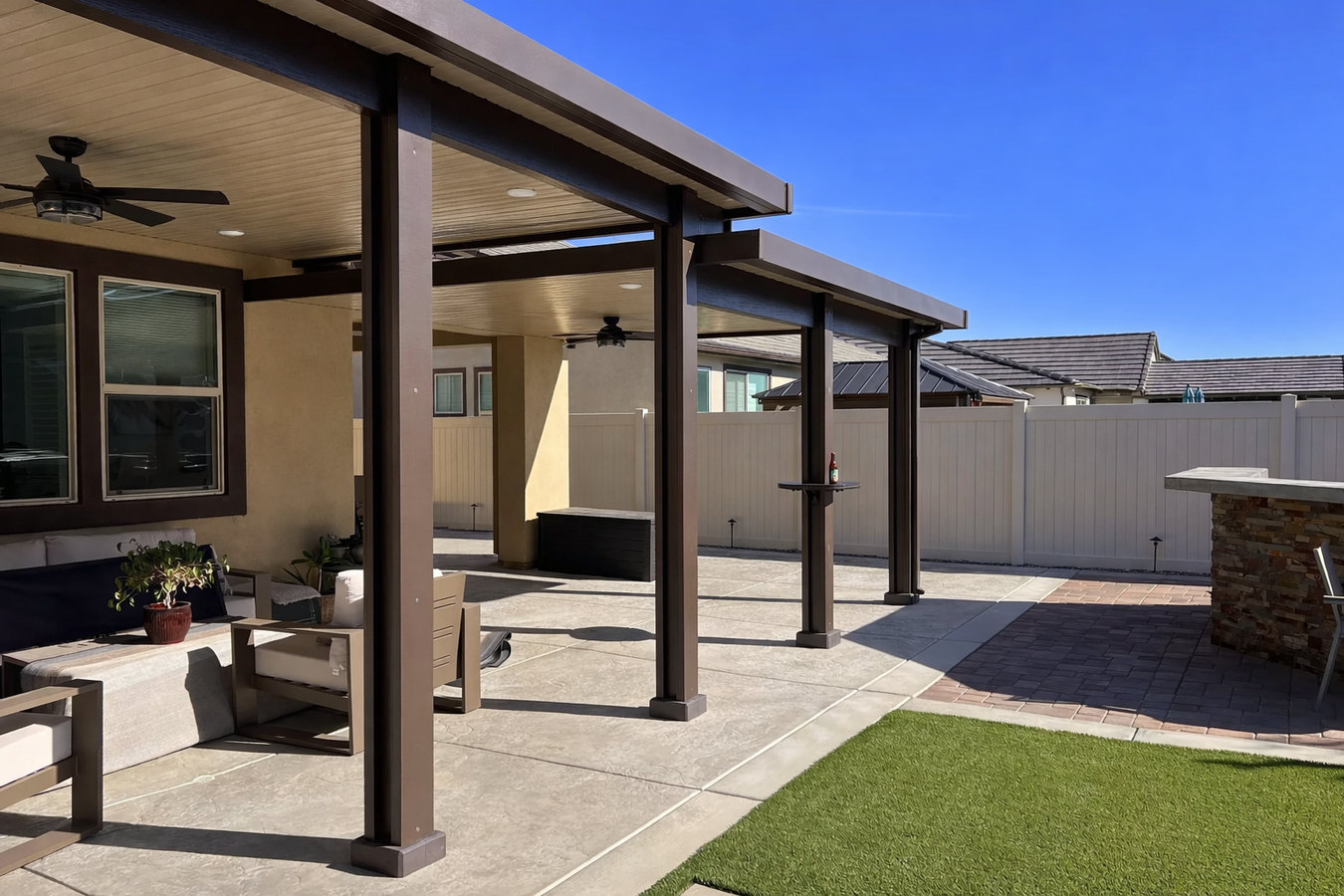
Your patio should not sit empty from June through September. A solid, permitted patio cover gives you shade, rain protection, and usable outdoor space every month of the year - built to handle what South Florida weather actually throws at it.
Your patio should not sit empty from June through September. A solid, permitted patio cover gives you shade, rain protection, and usable outdoor space every month of the year - built to handle what South Florida weather actually throws at it.
Patio cover installation in Wellington, FL attaches a permanent roof-like structure to your home that shades and protects your outdoor space, with most installations completed in one to three days once permits and HOA approvals are in hand.
A patio cover is not a screen room and not a full enclosure - it is the right step if you want usable outdoor space without the investment of a full glass room. Homeowners who want to go further later can pair a cover with a screen room installation on the sides, or explore what a complete sunroom design would look like. A cover solves the most immediate problem - Wellington's sun and afternoon rain - at a cost that makes sense for most budgets.
If your outdoor cushions bleach out, your table warps, or furniture degrades faster than it should, direct sun exposure is the problem. Wellington's UV intensity is among the highest in the continental United States, and unprotected patios bake everything on them. A solid patio cover dramatically extends the life of your outdoor furniture and keeps the surface temperature of your patio manageable.
If your outdoor space sits unused for four or five months every year because of heat and daily rain, that is a clear sign you need overhead protection. Wellington's rainy season is predictable and intense, and a covered patio turns those months from a write-off into usable living space. If you are only getting six or seven months of use out of an area you paid to build, a cover pays for itself quickly.
If water collects close to your home's exterior wall after a storm, your patio may be directing runoff the wrong way. A properly designed patio cover with a sloped roof and gutters can redirect water away from your foundation - which matters in Wellington, where the water table is high and drainage issues can escalate quickly into real structural problems.
If you already have an older patio cover and you are noticing rust streaks on the posts, sections that look like they are drooping, or a gap forming where the cover meets your roofline, those are signs the structure is failing. In Wellington's humidity and heat, aluminum and steel fasteners corrode faster than expected, especially on covers not installed with materials suited for a coastal climate.
Most of the patio cover projects we complete in Wellington use aluminum framing - because in South Florida's heat and humidity, aluminum does not rust, does not warp, and can be engineered to meet Palm Beach County's wind-load requirements. We install solid-roof covers with insulated panels for homeowners who want complete rain and sun protection, and louvered or lattice designs for those who prefer filtered light and airflow. For homeowners who want to take their covered patio a step further, we can pair the cover with a screen room installation on the perimeter to keep insects out while staying dry. If you are considering a more complete transformation, our sunroom design service gives you a full layout and materials consultation before any work begins. The National Association of the Remodeling Industry recommends asking to see completed local projects before hiring - we welcome that conversation.
Every cover we build is anchored properly into your existing concrete slab or a new footing, depending on the slab's condition. We check the slab during the estimate visit, pull the Palm Beach County building permit, and handle your HOA submission if you are in a governed community. Maintenance on an aluminum or vinyl cover is minimal - an annual rinse and a check of the fasteners after hurricane season is usually all it needs.
The most popular choice for Wellington homeowners who want complete rain and sun protection and plan to use the space through the summer rainy season.
For homeowners who want a cooler surface temperature under the cover and better thermal performance - especially useful when the covered space is adjacent to a conditioned room.
A good fit when filtered light and airflow are the priority and the space will primarily be used in the drier winter months.
Combines overhead rain and sun protection with insect screening on the sides - a popular upgrade for homeowners who want to use the space comfortably in the evenings.
Wellington sits in a wind-borne debris region, which means patio covers must be engineered and anchored to handle serious storm conditions - not just a strong afternoon gust. That requirement adds to the cost compared to what you would pay in a lower-wind state, but it also means your cover is not going to become a projectile during hurricane season. Wellington also receives heavy afternoon rain from June through September, so a cover without a properly sloped roof and drainage plan can direct water toward your home's foundation rather than away from it. Most Wellington homes were built on concrete slab patios, which is good news - in most cases we can anchor directly into the existing slab rather than pouring a new foundation, which saves time and money. The University of Florida IFAS Extension publishes practical home maintenance guidance for Florida homeowners, including advice on outdoor structures in the state's climate.
Wellington is one of the most HOA-dense communities in Palm Beach County, with dozens of planned neighborhoods governed by associations with their own exterior modification rules. We work regularly with homeowners across Wellington and neighboring areas including Royal Palm Beach and Greenacres. We know the HOA approval process here and help you prepare a submission that is complete the first time.
We ask a few basic questions - the size of your patio, whether you have an HOA, and what you are hoping to use the space for. Mention your HOA community at this stage because that affects the timeline and design options. We respond to all inquiries within one business day.
We visit your home to measure the patio, check how your roofline is configured, and assess the condition of your existing slab. We walk you through solid roof versus louvered options, materials, and whether electrical work like lighting makes sense, and give you a written estimate before we leave or within a day or two.
We prepare your HOA architectural review submission and pull the Palm Beach County building permit. These run on separate timelines - HOA approval can take two to six weeks depending on your community, and the county permit typically takes one to three weeks. Your project cannot start until both are approved.
Most standard patio covers go up in one to three days. We anchor the posts, build the frame, install the roofing panels or louvers, and seal the connection where the cover meets your home. A county inspector verifies the work meets the approved plans, and we do a final walkthrough so you know how everything drains and what to check after the first big storm.
Free on-site visit. We measure your space, walk you through your options, and handle the permit and HOA paperwork. No obligation.
(561) 576-0264Every cover we build is anchored and designed to meet the wind requirements that apply in Wellington's wind-borne debris region. We do not cut corners on post anchoring or structural connections - because in South Florida, those details determine whether your cover survives a storm.
We prepare your full HOA architectural review package and pull the Palm Beach County building permit on your behalf. You sign the paperwork - we handle the submission, the follow-up, and the inspection scheduling. You get a closed permit document when the job is done.
Wellington's flat terrain and sandy soil mean some existing slabs have settled or cracked over time. We check every slab during the estimate visit and tell you honestly whether it needs repair before we anchor into it. Skipping this step is how post anchors fail in the first storm.
We use aluminum framing and hardware suited for high humidity and coastal conditions - not catalog materials that corrode in a season. A cover built with the right materials for this climate holds up for decades with minimal maintenance. The{' '}Florida Roofing and Sheet Metal Contractors Association provides standards for roofing and cover installation specific to Florida conditions.
Taken together - wind-engineered anchoring, handled permits, a slab check before the first post goes in, and materials chosen for this climate - the result is a cover that does what it is supposed to do for years, not just through the first hurricane season.
If you are thinking beyond a cover and want a full layout and materials consultation for a complete outdoor room, sunroom design is the next step.
Learn MoreCombine a covered patio with screen enclosure sides to keep insects out while staying dry - a popular upgrade over a cover alone.
Learn MoreHOA and permit season books up fast - reach out now so you are not waiting for the next review cycle to start your project.